Posts

Showing posts with the label OECD

Who would you believe - Sharri Markson in the Daily Telegraph or the OECD?

Image
Sharri Markson in this morning's Daily Telegraph : Australians are among the highest-taxed citizens of any country in the world. We pay more personal income tax as a share of all tax revenue than any other OECD country except for Denmark. A report from the OECD released over Night:

When it comes to gender equality Australia is in the middle of the OECD pack

Image
A new OECD report " The pursuit of gender equality - An uphill battle " shows Australia is a mid-range performer among OECD countries across most gender equality outcomes. A comparison of countries shows young women in Australia have made significant gains in educational attainment, and now make up 58.7% of all graduates from undergraduate degree programmes – a share slightly above the OECD average. Despite this strong educational performance, women are less likely than men to engage in paid work and continue to earn less. The median full-time working woman in Australia earns 87 cents to every man's dollar, relative to an OECD average of 85.7 cents to the dollar. The report finds that many factors contribute to the gender wage gap, including women's higher likelihood of interrupting their careers for childrearing and employer discrimination. Another key contributor to the wage gap is job segregation by gender. Although Australian women are more likely than men to...

The difficult world economic environment for Australia's Teasurer

Image
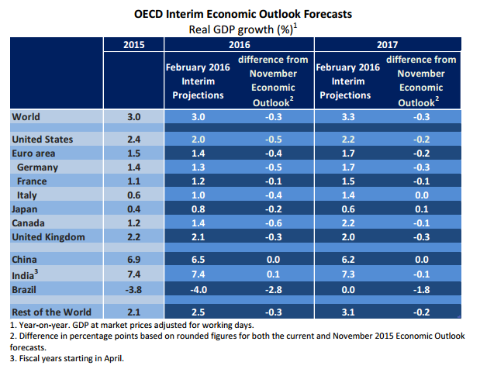
The OECD released overnight a rather gloomy update of the state of the world economy. Global GDP growth in 2016 is projected to be no higher than in 2015, itself the slowest pace in the past five years. Estimates for Australia are  not provided in this Interim Economic Outlook  but overall forecasts have again been revised down in light of disappointing recent data. In summary: Growth is slowing in many emerging economies with a very modest recovery in advanced economies and low prices depressing commodity exporters. Trade and investment remain weak. Sluggish demand is leading to low inflation and inadequate wage and employment growth.  Financial instability risks are substantial. Financial markets globally have been reassessing growth prospects, leading to falls in equity prices and higher market volatility. Some emerging markets are particularly vulnerable to sharp exchange rate movements and the effects of high domestic debt.  A stronger collective p...

Australia gets a good education report from an OECD PISA test

Image
Australian 15-year-old students are among the best performers in an OECD Programme of International Student Assessment (PISA)  survey of financial literacy . Among the 18 countries and economies that participated in the assessment, Australia ranks somewhere between 3 and 5. PISA 2012 defines financial literacy as “…knowledge and understanding of financial concepts and risks, and the skills, motivation and confidence to apply such knowledge and understanding in order to make effective decisions across a range of financial contexts, to improve the financial well-being of individuals and society, and to enable participation in economic life”. The PECD found that in Australia, financial literacy is strongly correlated with mathematics and reading performance. Around 79% of the financial literacy score reflects skills that can be measured in the mathematics and/or reading assessments (compared with 75%, on average, across OECD countries and economies), while 21% of the ...

Not just a matter of the GDP - OECD and defining well-being

Image
A reminder this week from the Organisation for Economic Co-operation and Development that the central purpose of economic policies is to improve people’s lives. With the release of an updated version of the report  How’s Life? ,  OECD Secretary-General Angel Gurria called for a rethink of “how to place people’s needs at the heart of policy-making” as data showed that the global economic crisis has had a profound impact on people’s well-being, reaching far beyond the loss of jobs and income. The OECD finds that over the past 20 years, OECD countries have made considerable progress in terms of overall well-being, but progress has been uneven between countries and in some countries, across population groups too. Since 2007, the crisis has had a profound impact on households’ economic well-being, as well as on people’s sense of well-being in several OECD countries. Income and wealth, jobs and earnings, subjective well-being and civic engageme...